
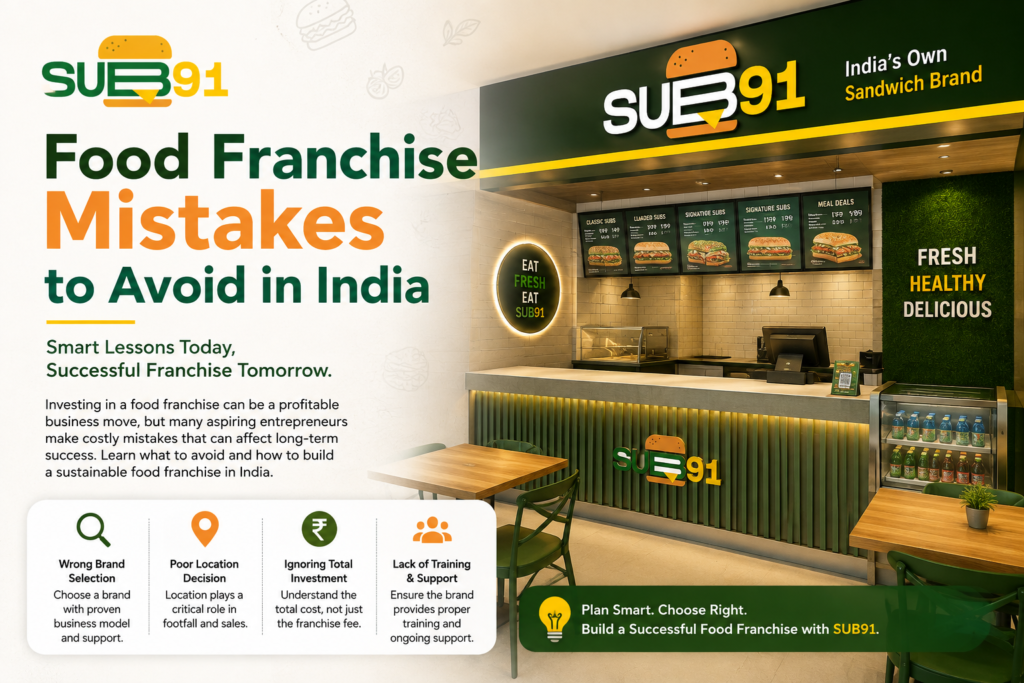
Food Franchise Mistakes to Avoid in India
Written by the SUB91 Franchise Team. SUB91 has onboarded 40+ franchise partners across 50+ cities, and this checklist is built from the questions we get asked most — and the ones first-time investors often forget to ask.
India’s food service industry is projected to keep growing at a fast clip through the rest of this decade, and franchising is capturing an outsized share of that growth — especially in Tier 2 and Tier 3 cities, where branded QSR penetration is still low and demand is rising fast. That growth is exactly why due diligence matters more, not less. A booming category attracts serious operators and shaky ones in equal measure, and the difference often isn’t visible until the money’s already spent.
If you’re evaluating a food franchise in India right now, here are the mistakes that trip up first-time investors most often — and what to check before you sign anything.
- Choosing a Brand Before Checking Unit Economics
It’s easy to fall for a brand you personally love without asking whether the numbers work in your city. Investment required, expected monthly footfall, average order value, and food cost percentage all vary by location — a model that breaks even in 15 months in a metro might take twice as long in a smaller town with lower footfall. Ask any brand for real, city-specific numbers, not just headline “starting from ₹X” figures.
- Not Reading the Franchise Agreement Line by Line
Royalty percentage, renewal terms, exit clauses, and territory exclusivity are where franchise agreements quietly differ the most — and where disputes usually start. A 2% royalty on monthly sales looks very different from a 6-8% royalty once you model it against your real margins. Ask specifically about territory protection: will the brand open another outlet three streets away from yours next year?
- Underestimating Working Capital Needs
The franchise fee and setup cost are only part of the picture. Most new food outlets need three to six months of operating buffer to cover rent, salaries, and inventory before the business becomes self-sustaining — and investors who don’t budget for this often run into cash flow trouble in month two or three, even when the concept itself is working.
- Skipping the “Talk to Existing Franchisees” Step
Every franchisor will tell you their support is excellent. The only way to verify that is to talk to people already running the brand — ideally two or three, in different cities. Ask about actual break-even time (not the projected one), how responsive the brand is when something goes wrong, and what they wish they’d known before signing.
- Picking a Location Without Real Footfall Data
A shop that looks busy at a glance can still have the wrong footfall profile — passersby who aren’t your target customer, or peak hours that don’t match your model. Visit a potential location at different times, including off-peak hours, and check what similar brands nearby are doing before committing to a lease.
- Ignoring the Supply Chain and Training Support
Fresh-food brands live or die by consistency. Before investing, ask exactly how ingredients are sourced and supplied, what training new franchise partners get before opening, and what ongoing operational support looks like once you’re live — not just at launch. This is one of the biggest gaps between franchise brands that scale well and ones that stall.
- Assuming a Bigger Investment Always Means a Safer Bet
A higher ticket size doesn’t automatically mean lower risk. Sometimes a leaner, well-supported model in the ₹20-30 lakh range with strong unit economics and Tier 2/3 city fit outperforms a heavier metro-first concept with slower breakeven. Match the investment to your city, your capital, and your risk appetite — not the other way around.
How SUB91 Approaches This
We built SUB91’s franchise model around exactly these questions, because we’ve sat across the table from investors asking them. Our current structure runs on a ₹20-30 lakh investment, an expected 15-24 month ROI window, and a flat 2% royalty on monthly sales — figures we share upfront rather than leaving for the fine print. We also lean into Tier 2 and Tier 3 cities deliberately: outlets are already open or coming soon in cities like Jalandhar, Gwalior, Kurukshetra, Ambala, Jaipur, and Bhatinda, which is exactly the kind of underserved market this checklist points toward. You can see the current numbers and support structure on our Franchise page, or read more about how we got here on our About Us page.
If you want the fuller picture of how franchising works step by step, our earlier guide on how to buy or start a franchise business in India walks through the process end to end, and our post on how profitable a healthy food franchise can be breaks down the numbers side in more depth.
Frequently Asked Questions
What is the biggest mistake first-time franchise investors make in India?
Skipping direct conversations with existing franchisees. Brand materials and sales conversations rarely tell you what actual day-to-day operations, support responsiveness, and real break-even timelines look like — only current franchise partners can.
How much working capital should I keep aside beyond the franchise fee?
Most food franchise operators recommend budgeting three to six months of operating expenses (rent, staff, inventory) separately from your initial investment, since it typically takes a few months to reach stable footfall.
Is a lower royalty percentage always better?
Not necessarily on its own — it matters more in context of what support you get for that royalty. A slightly higher royalty with strong supply chain, training, and marketing support can outperform a zero-royalty model with minimal backing.
What makes Tier 2 and Tier 3 cities attractive for food franchises right now?
Lower real estate and operating costs, less branded competition, and rising disposable incomes are drawing both investors and brands into smaller Indian cities, where the branded QSR category is still relatively under-penetrated compared to metros.
What’s SUB91’s current franchise investment range?
SUB91’s franchise investment currently ranges from ₹20-30 lakhs, with an expected ROI window of 15-24 months and a 2% royalty on monthly sales. Full details are on the Franchise page.
Thinking about a SUB91 franchise? Apply here or contact us directly — we typically reply within minutes.