
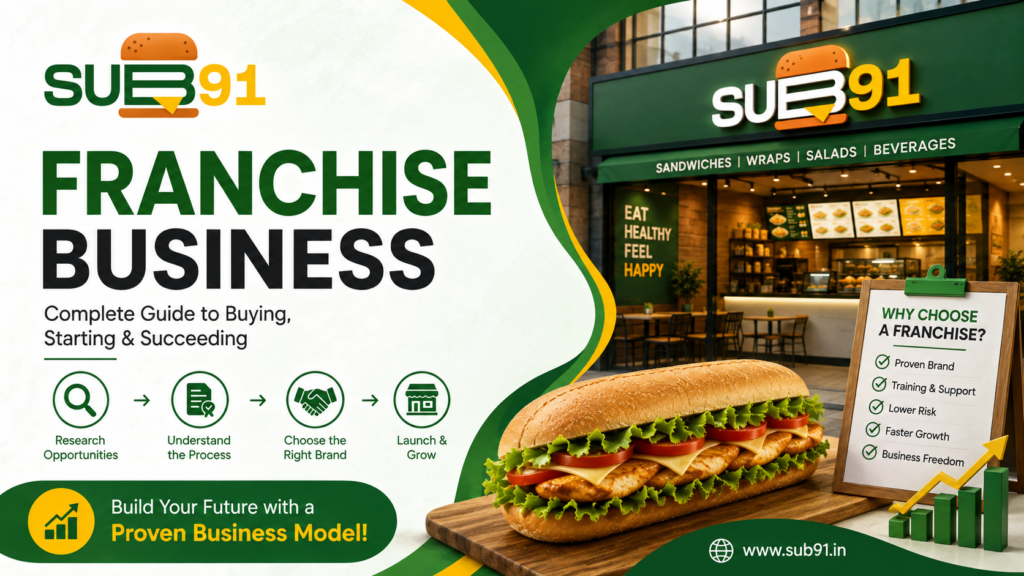
Franchise Business: A Complete Guide to Buying and Starting a Franchise
Starting a franchise business is one of the most common ways Indian entrepreneurs enter self-employment without building a brand from zero. But “buy a franchise” covers everything from a ₹2 lakh kiosk to a ₹5 crore hotel — and the difference between a good decision and a costly mistake usually comes down to how carefully you research before you sign. This guide walks through what a franchise business actually is, how the model works, what it really costs, how to evaluate one, and the step-by-step process of buying or starting one in India.
What Is a Franchise Business?
A franchise business is a licensing arrangement in which an established company (the franchisor) allows an individual or entity (the franchisee) to operate a business under its brand name, systems, and processes, in exchange for an upfront franchise fee and ongoing royalty payments.
The franchisor typically provides the brand, a tested operating model, training, and marketing support. The franchisee provides capital, a location, and day-to-day management, and operates under a franchise agreement that spells out territory rights, fees, obligations, and duration.
A simple real-world example: a fast-food brand with one successful outlet in Delhi wants to expand to Jaipur without opening and managing that store itself. Instead, it signs a franchise agreement with a local entrepreneur, who pays a franchise fee, sets up the outlet using the brand’s design and recipes, and pays a percentage of monthly sales back as royalty. The brand gets faster expansion with less capital risk; the franchisee gets a tested business model instead of starting from scratch.
How Does a Franchise Business Work?
At a direct level: a franchise business works by the franchisor licensing its brand and operating system to a franchisee, who invests capital to open and run an outlet under the franchisor’s guidelines, in return for training, support, and brand recognition, while paying fees and royalties back to the franchisor.
The typical lifecycle looks like this:
- Franchisor develops and proves a business model at one or more company-owned locations.
- Franchise agreement is signed, defining fees, territory, term, and obligations.
- Initial investment is paid — covering the franchise fee plus setup costs.
- Location and setup — the franchisee secures a site meeting the brand’s format requirements and builds it out.
- Training and support — staff and the franchisee are trained on operations, recipes/processes, and systems.
- Business operations begin under the brand’s standard operating procedures.
- Marketing — usually a mix of national/brand-level campaigns and local store marketing.
- Revenue and profit flow to the franchisee after covering costs, with royalty paid back to the franchisor.
Why Start a Franchise Business?
Franchising is attractive because it reduces — but does not eliminate — the uncertainty of starting a business from scratch. Common advantages include:
- An established brand with existing customer recognition
- A proven business model rather than an unproven idea
- Structured training for the owner and staff
- Ongoing operational and marketing support
- Negotiated supply chain relationships, often at better rates than an independent operator could get
- Less trial-and-error on menu, pricing, and store design
The honest counterpoint: franchising does not guarantee profit. You’re still taking on real financial risk, you’re bound by the franchisor’s rules (limiting flexibility), and outcomes vary hugely by location, local competition, category demand, and how well the franchisor’s support is actually delivered. Any brand claiming “guaranteed returns” should be treated with caution — no legitimate franchisor can promise that.
How to Buy a Franchise Business
Buying a franchise business is a structured process: define your budget, shortlist brands that fit it, verify the franchise disclosure and agreement, assess the location, calculate likely ROI, complete due diligence, then sign and launch. Below is the detailed sequence.
- Identify your budget — total capital available, including a buffer for working capital beyond the franchise fee.
- Research franchise opportunities — look across categories (food, retail, services, education) that match your interest and local demand.
- Compare franchise models — investment size, format (kiosk/dine-in/delivery-only), and support levels differ significantly between brands.
- Evaluate the brand — reputation, existing outlet performance, and how long it has operated.
- Understand the franchise cost — fee, setup, and recurring costs (see cost table below).
- Review the franchise agreement — territory rights, term, renewal, exit clauses, and obligations.
- Check location requirements — footfall, catchment, and site specifications the brand mandates.
- Understand training and support — what’s included, for how long, and at what cost.
- Calculate potential ROI — using realistic, brand-provided or independently verified numbers, not assumptions.
- Complete due diligence — speak to existing franchisees, verify legal and financial documents independently.
- Sign the agreement — only after legal review.
- Set up and launch — build-out, hiring, training, and opening marketing.
How to Buy a Franchise
To buy a franchise, shortlist brands within your budget, request their franchise disclosure documents and investment breakdown, visit existing outlets, negotiate and sign the franchise agreement, then complete setup and training before opening.
In practice, most Indian franchisors run this through an online enquiry → callback → site assessment → agreement → launch pipeline, similar to what SUB91 and comparable QSR brands use.
How to Purchase a Franchise
Purchasing a franchise typically follows this sequence:
- Initial enquiry — submit interest via the brand’s website or franchise team
- Franchise qualification — the brand assesses your budget, location, and fit
- Investment evaluation — you review the total cost and what it includes
- Business plan — a location- and city-specific projection
- Location selection — site shortlisting and approval
- Agreement — legal review and signing
- Payment — franchise fee and setup costs, usually in staged tranches
- Setup — store build-out and equipment installation
- Training — for the owner and hired staff
- Launch — grand opening, often supported by the brand’s marketing team
How to Start a Franchise Business
Starting a franchise business means moving from “I want to own a franchise” to an operating outlet. The path generally covers:
- Choosing an industry you understand or are genuinely interested in
- Selecting a specific franchise brand within that industry
- Planning your budget, including working capital
- Arranging financing (personal savings, loans, or a mix)
- Selecting and locking a location
- Signing the franchise agreement
- Completing store setup
- Hiring staff
- Completing brand training
- Running pre-launch marketing
- Opening the outlet
- Monitoring performance against targets and adjusting operations
Understanding Franchise Costs
Franchise cost is rarely a single number — it’s a bundle of one-time and recurring expenses. Actual figures vary by brand, city tier, format size, and location.
Cost Category | What It Covers | Why It Matters |
Initial franchise fee | Right to use the brand name and system | Non-negotiable entry cost; varies widely by brand |
Store setup / interiors | Civil work, furniture, branding, kitchen layout | Often the largest line item after the fee |
Equipment | Kitchen or service equipment specific to the format | Determines daily operating capacity |
Inventory | Opening stock of ingredients/products | Needed before day one of trading |
Licenses | FSSAI, trade license, GST, fire/health NOCs, etc. | Legal requirement to operate |
Working capital | Cash buffer for the first months of operations | Covers the gap before revenue stabilizes |
Marketing (launch) | Local opening promotions | Drives initial footfall |
Staff | Hiring and initial salaries | Recurring operating cost |
Rent / deposit | Property lease and security deposit | Fixed monthly commitment |
Technology | POS, ordering, and delivery platform integration | Needed for daily operations and reporting |
Royalty | Ongoing % of sales paid to the franchisor | Recurring cost throughout the franchise term |
Renewal fees (if applicable) | Cost to extend the agreement after the initial term | Relevant for long-term planning |
Franchise Due Diligence: What to Check Before Buying a Franchise
What should you check before buying a franchise? At minimum: the brand’s reputation and outlet track record, direct feedback from existing franchisees, the full franchise agreement (territory, royalty, exit, renewal terms), realistic investment and ROI figures, and the viability of your specific location — verified independently rather than taken solely from the franchisor’s pitch.
A fuller checklist:
- Brand reputation and how long it has operated
- Number and performance of existing outlets
- Direct, unfiltered franchisee feedback (not just brand-selected testimonials)
- Total financial requirement, staged clearly
- Full franchise agreement, ideally reviewed by a lawyer
- Territory/exclusivity rights
- Royalty structure and any hidden fees
- Marketing fund contributions and how they’re spent
- Supplier requirements and whether sourcing is mandated
- Depth of training provided
- Ongoing operational support — and what it costs, if anything, after year one
- Exit conditions if you want to leave the franchise
- Renewal conditions at the end of the term
- Realistic investment-to-revenue expectations for your city tier
- Location viability — footfall, competition, and catchment demographics
You should independently verify financial and legal claims rather than relying only on brand-provided material — this is standard practice before any franchise investment, not a sign of distrust.
Franchise Business vs Starting From Scratch
Factor | Franchise Business | Independent Business |
Brand Recognition | Inherited from franchisor | Built from zero |
Business Model | Pre-tested by franchisor | Self-designed, unproven |
Training | Usually provided by franchisor | Self-taught or hired-in |
Marketing | Shared brand + local support | Entirely self-funded |
Operational Support | Ongoing from franchisor | None; owner solves alone |
Flexibility | Limited by brand standards | Full control over decisions |
Initial Costs | Franchise fee + setup | Setup only, but no fee |
Risk | Lower model risk, brand-dependent | Higher model risk, fully owner-dependent |
Neither path is universally “better” — franchising trades flexibility for a tested system; independent business trades certainty for full control.
Food and QSR Franchises in India
Food and QSR (Quick Service Restaurant) franchises remain one of the most popular categories for first-time franchisees because food is a recurring, non-discretionary purchase and formats can range from small kiosks to full dine-in outlets. Key factors that determine success in this category include:
- Location — footfall, visibility, and proximity to offices, colleges, or residential catchments
- Menu — width, price points, and local taste-fit
- Food quality and consistency — the single biggest driver of repeat visits
- Supply chain — reliable, fresh sourcing at scale
- Staffing — trained, consistent service
- Customer experience — speed, hygiene, and ambience
- Delivery platform presence — Zomato/Swiggy visibility matters as much as walk-in traffic in most Indian cities today
- Local marketing — geo-targeted offers and community engagement
- Repeat customers — the real measure of a healthy QSR unit, more than one-time footfall
- Operational consistency — every outlet delivering the same experience is what protects the brand long-term
Is SUB91 a Franchise Business Opportunity?
If you’ve been researching food franchises specifically, SUB91 is one option worth evaluating on its own merits. SUB91 is an Indian QSR brand built around customizable submarine sandwiches, founded in 2022 in Delhi by Hemant Khatana and Himanshu Choudhary, and operated by Havesub India Private Limited. The brand positions itself around what it calls the HACK principle — Healthy, Affordable, Customizable, Kitchen-fresh — and has expanded primarily across North India, with an operational presence across Punjab, Haryana, Delhi NCR, Uttarakhand, and Jammu, and stated plans for further cities.
On its franchise page, SUB91 lists an all-inclusive investment range of ₹20–30 lakhs, a royalty of 2% of monthly sales, and a company-stated ROI expectation of 15–24 months. These are figures published by SUB91 itself, not independently audited, so treat them as a starting point for your own due diligence rather than a guarantee — the same standard you’d apply to any franchisor.
SUB91’s stated franchise process runs through four stages on its site: apply online, a discovery call with the franchise team, due diligence and location assessment, and store setup with training and launch marketing support. The brand also publishes partner testimonials and outlet-performance figures on its franchise page; as with any franchisor’s self-reported success stories, it’s worth asking to speak directly with existing franchise partners as part of your own verification before committing capital.
If the QSR/food category fits your budget and interest, it’s reasonable to explore the SUB91 franchise opportunity alongside other brands in the same investment bracket, apply the due-diligence checklist above, and compare it against at least one or two other food franchises before deciding.
Conclusion
A franchise business can be a genuinely lower-risk way to become a business owner — you get a tested model, a recognizable brand, and structured support instead of building everything from nothing. But “lower risk” isn’t “no risk”: costs, location, and the quality of the franchisor’s support all still determine whether a specific outlet succeeds. Whether you’re comparing a food franchise like SUB91 or a completely different category, the process is the same — define your budget, shortlist brands, verify everything independently, and only then sign.
FAQ Section
- What is a franchise business?
Ans).A franchise business is a licensed arrangement where a franchisee pays a franchisor for the right to operate under its brand, systems, and support in exchange for fees and ongoing royalty payments.
- How does a franchise business work?
Ans).The franchisor licenses its brand and tested operating model to a franchisee, who invests capital, sets up the outlet, receives training and support, and runs day-to-day operations while paying royalty back to the franchisor.
- How to buy a franchise business?
Ans).Set your budget, research and compare brands, review the franchise agreement and cost structure, assess the location, complete due diligence by speaking to existing franchisees, then sign and launch.
- How to buy a franchise?
Ans).Shortlist brands within budget, request their investment breakdown and disclosure documents, visit existing outlets, negotiate and sign the agreement, then complete setup and training.
- How to purchase a franchise?
Ans). Submit an enquiry, go through the brand’s qualification and investment evaluation, select a location, sign the agreement, pay the staged fees, complete setup and training, then launch.
- How to start a franchise business?
Ans). Choose an industry and brand, plan your budget and financing, secure a location, sign the agreement, complete setup, hire and train staff, then launch and monitor performance.
- How much money do I need to buy a franchise?
Ans).It varies enormously by brand and format — from a few lakhs for a small kiosk to several crores for larger formats. Always get the franchisor’s full, itemized cost breakdown rather than relying on the headline “investment required” figure alone.
- Is buying a franchise better than starting a business from scratch?
Ans).Neither is universally better. Franchising offers a tested model, brand recognition, and support in exchange for fees and less flexibility; an independent business offers full control but no proven system or brand pull.
- What should I check before buying a franchise?
Ans).Brand reputation, existing outlet performance, direct franchisee feedback, the full franchise agreement, real costs and royalty structure, training and support depth, and your specific location’s viability — all verified independently.
- Is a food franchise a good business opportunity?
Ans).It can be, since food is a recurring purchase, but success depends heavily on location, food quality and consistency, supply chain reliability, and local competition — not on category alone.
Rudr shiva dhaba panipat
Panipat franchise best location